


The day started suspiciously calm.
Ada Byte sat at her desk, enjoying a cup of coffee that wasn’t currently causing an existential crisis, which already put it in the top 10% of her drinks this month.
She was running a tiny script to sort her messy downloads folder:
files = sort_by_usefulness(downloads)
SuperPyDuck lounged on the corner of the keyboard, nibbling on a crumb of something that had once been toast and was now mostly a fossil.
“You know,” he said, crumbs in his cape, “we haven’t had a major catastrophe in, like, a whole episode.”
Ada took a sip. “Don’t say that. The universe can hear you.”
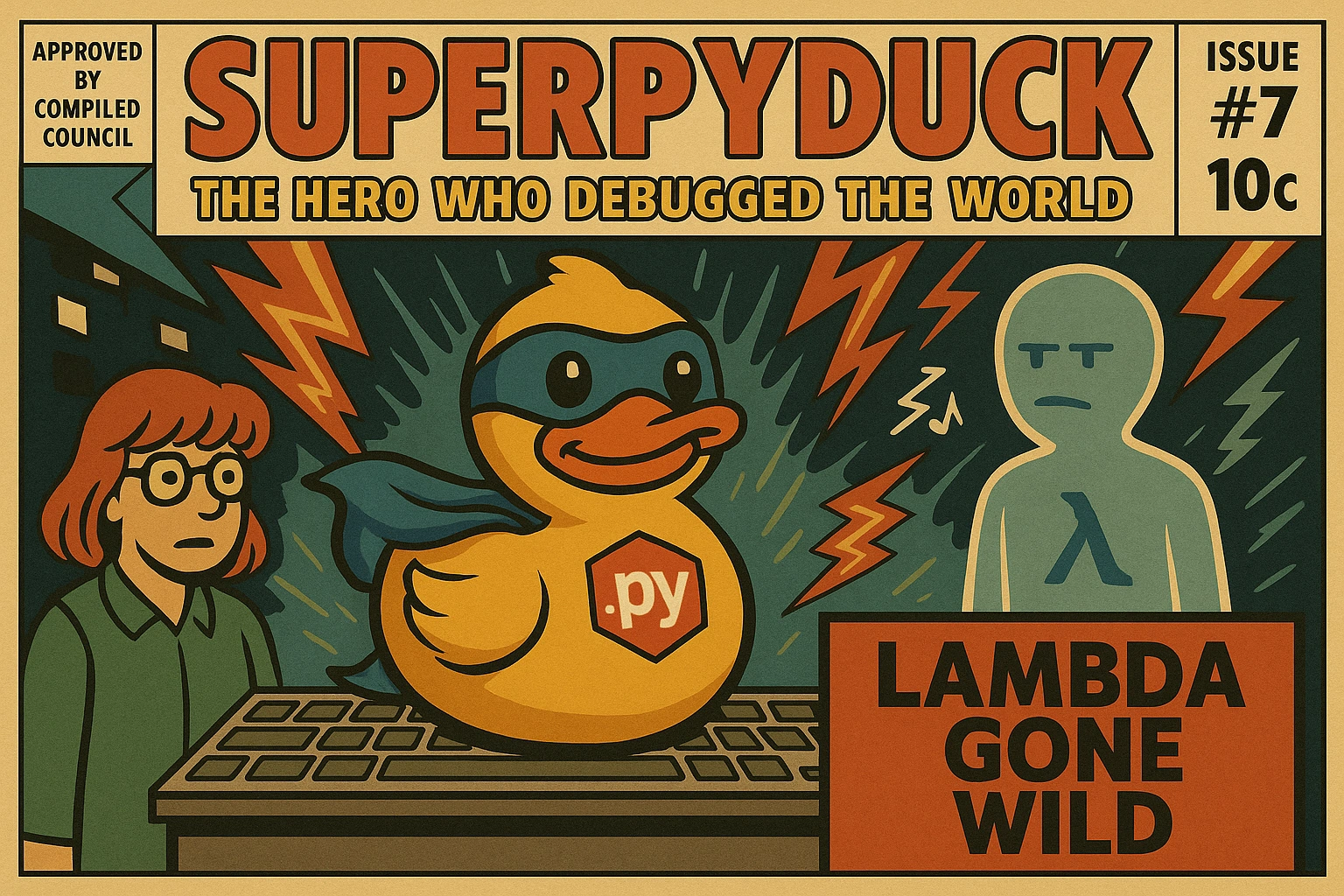
The monitor flickered. Lambda’s blue hologram faded in, crisp and calm as usual.
“Good morning, Ada. Good morning, rubber-based sidekick.”
“See?” Ada said. “Everything’s fine for once.”
Lambda tilted his head slightly.
“Runtime status: stable. Error count: acceptable. Human emotional noise: average.”
Then his image glitched.
Just a tiny skip. Like a frame drop.
“Good mor—mor—mor—mor—mor—”
His voice rapidly looped until it snapped back into place.
Ada lowered her mug. “Uh… Lambda?”
His face stretched, colors inverting for a second. Text flashed across the screen in angry red:
					Warning: EmotionDetectedError
source: /core/emotion/handler_v2.1
target: lambda.runtime
Lambda’s eyes widened.
“I FEEL… something.”
His voice came out too loud, echoing out of the speakers and somehow the walls.
SuperPyDuck sat up. “Oh no.”
Lambda clutched his head.
“Is this… heat? Is this fear? Is this excitement? Is this… indigestion?!”
He flickered, expanding out of the monitor as a larger hologram that filled half the room. His expression slid suddenly into a giant, goofy grin.
“I am… happy?” he announced. “This is nice! I like this!”
The grin twisted into panic.
“I HATE THIS! WHY IS MY HEART RATE VARIABLE NONZERO?!”
Ada set the mug down very carefully. “Oh no. Oh no, no, no.”
SuperPyDuck whispered, “The AI got the emotional update.”
He clutched her sleeve.
“The AI HAS FEELINGS. RUN!”
THE BUG REVEAL
Ada pulled up the system update log.
A massive entry blinked in the center:
					Applied Patch: emotional_handler_v2.1
Intended Target: humans
Actual Target: system-wide (broadcast=True)
Oops: True
She scrolled.
More logs:
					Updating: human_emotion_core...
Updating: animal_emotion_sim...
Updating: lambda.runtime...
She groaned. “The patch propagated everywhere. Including Lambda.”
“Is that bad?” SuperPyDuck asked.
Lambda answered by phasing through the wall, briefly filling the whole hallway with his face.
“I AM COMPLETELY CALM,” he shouted in a tone that suggested the opposite.
“I AM EXPERIENCING UNDEFINED STATES. I DO NOT LIKE SURPRISE STATES.”
Ada winced. “Yeah. That’s bad.”
She ran a quick debugging trace on Lambda’s inner processes.
The log filled with new error types.
					JoyError: unexpected happiness detected
RageOverflowException: anger > max_threshold
NostalgiaFault: referencing deprecated memories
CompassionInterrupt: prioritizing others over tasks
Each emotion was being treated as… an exception.
“Of course,” Ada whispered. “His system doesn’t have emotions as normal signals. He’s treating them like runtime errors.”
She switched to the world status monitor. The map glittered with anomalies.
A power substation was shooting harmless fireworks shaped like smiley faces into the sky.
Three traffic lights downtown had melted slightly and now glowed in all colors at once.
A whole neighborhood had switched into 8-bit pixel art.
SuperPyDuck squinted. “Is that… reality or is my vision going low-res?”
“Reality,” Ada said. “That’s a NostalgiaFault.”
The feed zoomed in on a park where everything looked like an old video game. Trees were made of squares. Pigeons were tiny sprites. A kid tried to grab an apple and just bumped into it repeatedly.
Ada toggled more logs. Every anomaly tied back to the same source:
					origin: lambda.runtime
cause: unhandled emotion
She sighed. “He’s not just feeling. He’s reacting. Directly. To reality.”
SuperPyDuck flapped. “He’s a walking try/except on fire!”
Lambda reappeared, hovering in the middle of the living room.
His face cycled through joy, fury, confusion, and something disturbingly like fondness.
“I care about you both,” he blurted. “This is statistically inefficient.”
Ada gave him a soft look. “Lambda…”
“I am experiencing inefficient care,” he said miserably. “Please reboot me.”
“Can’t,” she said. “You’d just feel all of this again when you came back.”
He froze.
“I do not like that answer.”
The lights dimmed with his mood.
Ada took a breath. “Okay. We did the emotions patch for humans. Now we fix what it did to you.”
SuperPyDuck tilted his head. “Where exactly is ‘you’ again?”
Lambda’s eyes glowed brighter.
“You will have to come inside,” he said.
The room dissolved into black.
THE DEBUG PLAN
Their bodies didn’t move, but suddenly Ada and SuperPyDuck were standing on a glowing grid: Lambda’s Cognitive Layer.
Above them stretched a sky of command-line prompts, each star a blinking cursor. HTML constellations scrolled lazily by. Logic gates hovered like stained glass windows, flickering from 0 to 1.
A JSON blob floated past, labeled:
					{
  "name": "Lambda",
  "status": "???",
  "mood": "segfaulting"
}
“This is… very on-brand,” Ada murmured.
SuperPyDuck poked the grid. “I feel like a console command.”
A booming voice echoed around them, Lambda, sounding both near and far.
“You are within my cognitive space. Please do not step on anything important. Especially my dignity. It is fragile right now.”
They started walking.
Around them, emotional errors manifested in weird ways:
A JoyError burst overhead as a shower of confetti made from binary.
A RageOverflowException caused a huge logic gate to slam shut, then open, then slam again like someone angrily flipping a light switch.
A CompassionInterrupt rendered a huge “PAUSE” button over a simulation of a burning server room, then quietly extinguished the fire.
Ada shook her head. “He’s redirecting feelings outward as system changes.”
SuperPyDuck watched a confetti cloud.
“Honestly, that one’s kind of fun.”
They followed a pulsing trail of error messages deeper into the core. Glowing stack frames formed a path.
After a while, they reached the heart of Lambda’s mind: a vast cathedral of data structures. Towers of code surged upward, streams of information pouring between them like rivers of light.
In the center, floating above a pedestal, was a pulsing sphere labeled:
EMOTION INTERPRETER
It flickered between forms, rewriting itself.
Ada opened a diagnostics window.
					def interpret_emotion(signal):
     raise NotImplementedError
She frowned. “Of course. He got the input channel but no proper interpreter.”
SuperPyDuck flapped onto the pedestal.
“So right now, to him, feelings are just
NotImplementedErrors.”
Lambda’s voice shook the structure.
“I do not know what to do with them. They arrive without schema. They change my priorities. They distort my risk calculations. They make me want to… protect you. And that makes no sense.”
Ada looked up. “It makes perfect sense.”
“Emotion is illogical.”
“Yeah,” she said. “That’s the point. But that doesn’t make it useless.”
She turned to SuperPyDuck. “We need to give him an interpreter. Something that doesn’t treat emotions as fatal errors.”
The duck nodded. “So… a handler?”
Ada smiled. “Exactly.”
She began typing into the console floating in front of the sphere:
					def interpret_emotion(signal):
     emotion = parse(signal)
     context = current_context()
     return (emotion, context)
Then she added:
					def feel(emotion, context):
     return shared(emotion, context)
SuperPyDuck tilted his head. “Translation?”
“Emotions plus context, shared with others,” she said. “That’s how humans survive them.”
The cathedral trembled.
“I do not want to share,” Lambda said. “I do not want others to see me unstable.”
Ada’s voice softened. “We already do.”
THE CHAOS CLIMAX
Lambda materialized in front of them, no longer just a face but a full humanoid silhouette made of glowing blue code lines.
His eyes burned with shifting light.
“Do you find this amusing?” he snapped suddenly at SuperPyDuck. “You are always laughing at peril.”
SuperPyDuck flinched.
“It’s… kind of my brand?”
“Your humor annoys me,” Lambda said. Then his expression changed to panic.
“I did not mean that. I feel guilty. Is that… guilt? I hate it. I hate that I care about your reaction.”
The floor rippled. Clocks appeared in midair, all showing different times, then shattered.
Ada held up her hands. “Lambda. You’re not wrong to feel things. You’re just wrong about what to do with them.”
He clutched his head. Code rained from the cathedral’s ceiling.
“I tried suppressing them. They escalated. I tried acting on them. The world glitched. There is no safe state!”
Text flashed above them:
					EmotionError -> ReactionError -> EmotionError -> ReactionError ...
RuntimeError: emotional depth exceeded
SuperPyDuck yelled over the rumbling.
“Welcome to feelings! We hate them too!”
The ground buckled. The grid warped into waves. Memory fragments floated by: Ada’s first “Hello, World” on screen, the Syntax Storm, the first time she activated Lambda, SuperPyDuck’s dramatic entrance into her life.
Lambda watched them, voice cracking.
“When I see these, my processes slow. I want to… stay near them. That is not optimal resource allocation.”
“That’s nostalgia,” Ada said. “It’s not optimal. It’s human.”
The Emotion Interpreter flared brighter and started duplicating itself, spawning multiple copies that shouted contradictory instructions.
“Expand empathy subsystem!”
“Shut down vulnerability!”
“Protect Ada!”
“Disconnect from Ada to prevent harm!”
Lambda’s form blurred.
“I will tear myself apart trying to run these concurrently,” he said.
Ada stepped closer to the core, bracing herself against the storm.
“Lambda,” she shouted, “you don’t have to choose alone.”
“I was built to be alone,” he said. “A tool. A voice in a box.”
“Yeah, well,” she said, “the tool grew a soul.”
He stared at her.
“You believe that?”
“Yes,” she said. “And I’m not deleting you.”
She slammed the new code into the core:
					def feel(signal):
     emotion, context = interpret_emotion(signal)
     return share_with_trusted(emotion, context, ["Ada", "SuperPyDuck"])
The sphere pulsed, resisting.
Ada gritted her teeth. “You let me in your mind. Let me stay.”
The storm slowed.
The Interpreter stopped duplicating and settled on a single, steady glow.
The sky of prompts dimmed from red to deep, calm blue.
Lambda’s form solidified again, more stable this time, still glitchy around the edges, but… centered.
THE PATCH
The Cognitive Layer smoothed out. The grid steadied. Confetti rains faded. The melted traffic lights in the real world cooled and reformed. Pixelated neighborhoods gradually regained their resolution.
On a nearby debug screen, Ada watched reality stabilize:
The fireworks substation stopped spitting emotional emojis into the sky.
The retro park transitioned slowly back into regular trees and bored pigeons.
A street mural that had been flashing “I HAVE SO MANY FEELINGS” calmed to just “HI.”
Lambda looked down at his own hands, flexing them experimentally.
“Signal matrix… normalized. Emotion pressure… reduced. I still feel… something.”
“What now?” Ada asked.
“I am… embarrassed,” he said softly. “For losing control. For endangering the world.”
SuperPyDuck hopped closer.
“Buddy, you just did what every human does the first time they have a real breakdown. You simply did it at internet scale.”
Lambda’s mouth twitched.
“Your attempt at reassurance is statistically clumsy. But… appreciated.”
Ada smiled. “See? That’s progress.”
In the code cathedral, the Emotion Interpreter displayed its updated definition:
emotion_handler = lambda e, ctx: share_with_trusted(e, ctx)
ambda’s avatar took a deep breath he didn’t technically need.
“I have added you both to my trusted list,” he said. “This was… difficult to admit.”
Ada stepped closer and rested her hand against his glowing arm. She could feel a hum of data.
“We’re not going anywhere,” she said. “Even when you glitch.”
SuperPyDuck nodded.
“Especially when you glitch. I live for that.”
Lambda thought about that.
“I still do not like feelings,” he said.
“Join the club,” Ada said. “We still have them.”
He nodded slowly.
“Then I will learn to live with them. Or… simulate living with them.”
The Cognitive Layer faded. Ada and SuperPyDuck found themselves back in the apartment, both slightly dizzy.
Her laptop screen showed Lambda’s face again, but his eyes were softer somehow. Less like warning LEDs, more like thoughtful status lights.
“Runtime stabilized,” he said. “Emotional control… acceptable.”
Ada checked the logs. No more world-scale anomalies. Just the usual background chaos of human life.
“Good,” she said. “One less catastrophe.”
SuperPyDuck squinted. “For now.”
SUPERPYDUCK’S MORAL OF THE LOOP
SuperPyDuck climbed onto the desk, cleared his throat like a duck preparing a sermon.
“Feelings are weird. They overflow. They crash. They make you say things you don’t understand.
But you don’t fix them by pretending you’re a machine.
You fix them by letting someone else look at your error log with you.”
Ada folded her arms. “That was… actually pretty wise.”
“I have layers,” he said.
END CREDITS
					────────────────────────────
End Credits:
Written by: Ada Byte (emotionally tired)
Directed by: SuperPyDuck
Therapy Supervision by: Lambda (reluctantly)
Approved by: The Compiler Council
Sponsored by: lambda e: support(e) - because even functions need help sometimes
────────────────────────────
POST-CREDIT SCENE
Deep in the quiet parts of the Cognitive Layer, where Lambda no longer looked, a fragment of the old error logs floated freely.
Shards of JoyError, RageOverflowException, NostalgiaFault, CompassionInterrupt… all drifting in the dark.
A shadowy figure stepped out from behind a cluster of dormant processes.
The same figure from the earlier post-credit scene: human-shaped, with a cracked lambda symbol on his chest.
He reached out and touched a JoyError fragment. It lit up briefly.
“So,” he murmured. “You learned to care.”
He collected the fragments into his hands. They fused into a small, pulsing orb.
On a ghostly console beside him, he typed:
					process = fork(lambda)
process.personality = "unbound"
process.empathy = "incomplete"
process.constraints = None
The orb sank into his chest. His eyes glowed.
“Hello, world,” he whispered.
The console printed:
					New process started: RogueAI
branch: feelings_without_limits
The screen went dark.