
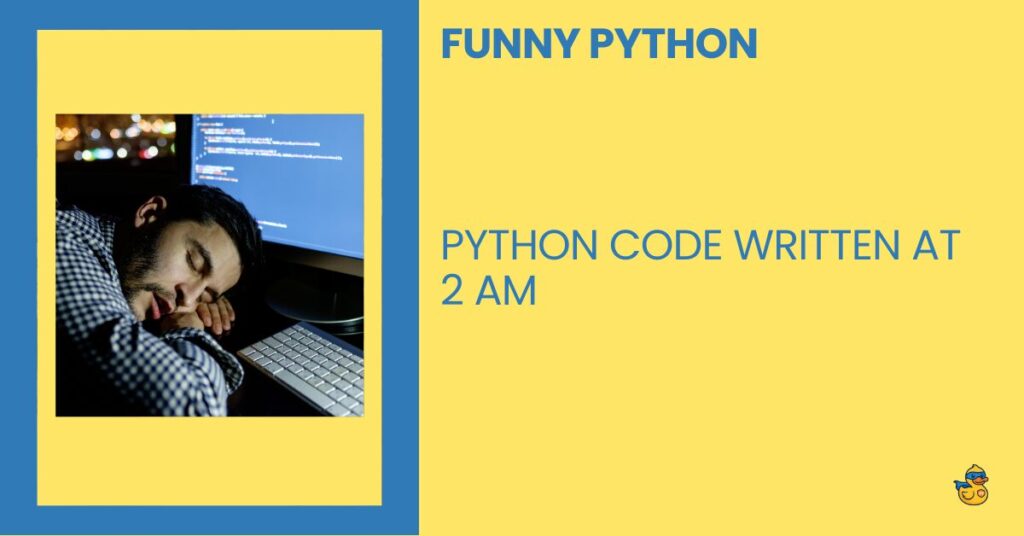


Nothing good happens at night, especially Python code written at 2 AM.
And yet, this is when some of the most… creative Python code is born.
You didn’t plan to be here. You were just going to fix one small thing. A tiny tweak. Five minutes, tops. And now it’s 2 AM, your brain is running on fumes, and you’re absolutely convinced that this solution makes perfect sense.
It does not.
At 2 AM, Python code has a very specific personality. Variable names become abstract concepts. Comments turn into warnings. Logic works, but only if you don’t ask why. And somehow, despite everything, the program runs.
This isn’t bad code. This is 2 AM code. Code written by a tired human making confident decisions they will not remember tomorrow.
If you’ve ever opened a Python file the next morning and thought, “Who wrote this?” only to realize it was you… welcome. You’re in the right place.
Let’s take a look at what Python code written at 2 AM really looks like.
Want more funny Python stuff? Read this: Top 20 Funny Python Codes That’ll Make You Laugh
The 2 AM Mindset (False Confidence Phase)
At 2 AM, something strange happens to your brain. You’re tired, slightly wired, and completely convinced you’re operating at peak performance. The bug looks obvious. The fix feels elegant. You don’t even bother opening Stack Overflow because, honestly, you’ve got this.
This is the phase where python code written at 2 am starts to get bold.
You make decisions quickly. Too quickly. You remove “unnecessary” lines of code. You rewrite functions without tests. You rename variables in a way that feels logical in the moment and deeply confusing later. Everything feels clean, even when it absolutely is not.
Comments seem optional. Formatting feels like a future problem. You tell yourself you’ll refactor in the morning, as if morning-you is some kind of organized superhero with unlimited patience.
And the most dangerous part?
The code works.
That tiny success reinforces the confidence. You run it one more time, just to be sure. Still works. Perfect. Ship it. Go to bed. Tomorrow-you can deal with the rest.
Tomorrow-you is going to be furious.
Variable Names That Deserve Prison Time
At 2 AM, naming things feels optional. You know what the variable means right now, so future clarity feels like an unnecessary luxury. This is how python code written at 2 am slowly loses all connection to reality.
Suddenly your code is full of variables like:
xtemptemp2thingthingydatafinalfinal2final_final_this_time
And the worst part? At 2 AM, these names feel reasonable. Almost elegant. You tell yourself, “I’ll rename it later,” even though deep down you know later is a lie.
The logic becomes a scavenger hunt. You scroll up. You scroll down. You trace temp2 through five functions, only to discover it was created as a quick experiment that somehow became essential to the program’s survival.
This is the moment when your code stops being readable and starts being archaeological. Every variable is a mystery. Every name is a clue. And none of them explain why the value exists.
At 2 AM, variable names aren’t descriptive.
They’re vibes.
And tomorrow morning, you won’t remember a single one of them.
Logic That Technically Works (Somehow)
This is where python code written at 2 am becomes truly dangerous. Not because it crashes. Not because it throws errors. But because it works just enough to convince you everything is fine.
The logic starts getting… creative.
Conditions are flipped because “it felt right.”if not not condition: appears and no one remembers why.
Loops exist inside other loops that probably don’t need to be there, but removing them feels risky, so you leave them alone.
You write things like:
checking the same condition twice “just to be safe”
handling edge cases before the main case
adding an
elsethat should never run, but absolutely will
At 2 AM, clarity is replaced by momentum. You stop asking “is this the best way?” and start asking “does this stop the bug?” If the answer is yes, you move on immediately.
The code becomes a series of defensive maneuvers. You don’t fully understand the logic anymore, but you trust past-you. Past-you had reasons. Probably.
And when you read it the next morning, the logic feels hostile. It’s not wrong. It’s just… unexplainable. Like it was written by someone who understood the problem emotionally, not logically.
That’s the magic of 2 AM logic.
It works.
It passes tests.
And no one, including you, should ever touch it again.
Comments Written for Future You (Who Will Suffer)
At 2 AM, comments feel like a kindness. A gift to your future self. You’re tired, but you’re still thoughtful enough to leave a few notes behind. Unfortunately, those notes are written by someone who is wildly overestimating how much future-you will remember.
This is prime territory for python code written at 2 am.
You leave comments like:
# fix later# don't touch this# temporary# works, somehow# TODO
At the time, these comments feel responsible. You’re acknowledging technical debt. You’re being honest. You’re practically a role model.
But when morning comes, those comments read less like guidance and more like threats.
# fix later has no timeline.# temporary has been there for six months.# don't touch this is guarding code you now desperately need to change.
The worst one is # TODO. It promises clarity. It delivers nothing. It’s a monument to good intentions and poor follow-through.
At 2 AM, comments aren’t explanations.
They’re apologies.
And future-you is not amused.
This ones funny too: 10 Python Code That Does Nothing (And Does It Perfectly)
The “I’ll Refactor This Later” Lie
Every piece of python code written at 2 am is held together by one comforting thought: I’ll clean this up later. Not now. Not tonight. Later. A calm, responsible version of you will take care of it.
That version of you does not exist.
At 2 AM, refactoring feels unnecessary because the code already works. Touching it feels risky. You’ve finally reached a fragile peace where nothing is broken, and the idea of changing anything sounds exhausting. So you promise yourself you’ll come back with fresh eyes.
What actually happens is this:
the code ships
it gets used
it becomes “important”
and now nobody wants to touch it
The messy function becomes critical infrastructure. The hack becomes a feature. The quick fix becomes legacy code.
Refactoring later turns into refactoring never.
And the cruel twist? By the time you do come back to it, you no longer understand what problem the code was solving in the first place. The context is gone. The energy is gone. The confidence is gone.
The lie wasn’t that you didn’t care.
The lie was that later would be easier.
Debugging at 2 AM Is Just Guessing With Confidence
At some point, python code written at 2 am stops being debugged and starts being negotiated with. You’re no longer fixing the problem. You’re experimenting emotionally.
The process usually looks like this:
add a
print()run the code
stare at the output
add another
print()move a line of code “just to see what happens”
There is no plan. There is only momentum.
You stop trying to understand why the bug exists and start trying things until it goes away. If it disappears after a change, that change must have been correct. You don’t question it. Questioning is a daytime activity.
Variables get moved. Conditions get flipped. Code that “felt suspicious” gets deleted on instinct alone. Sometimes it works. Sometimes it makes things worse. But you’re too tired to tell the difference anymore.
The real danger isn’t that this method is chaotic. It’s that it often succeeds.
By sheer accident, the bug disappears. The program runs. Victory is declared. And you go to bed with the deep, unsettling knowledge that you don’t actually know what fixed it.
That’s 2 AM debugging.
No understanding.
No certainty.
Just confidence and hope.
Code That Should Not Work (But Does)
This is the final form of python code written at 2 am. The code runs. The output is correct. The bug is gone. And yet… the program feels wrong in a way you can’t explain.
It’s not clean. It’s not logical. It’s not even readable. But it works, and at 2 AM that’s the only definition of “good.”
This is where you end up with code patterns like:
functions that return three different types depending on the mood
variables created “temporarily” that become permanent
conditions that look upside down but apparently aren’t
magic numbers that nobody dares to touch
one line that must stay exactly where it is, or everything collapses
You also start seeing the classic sign of late-night coding: fixes stacked on fixes. Like duct tape over duct tape.
The first fix makes it work.
The second fix makes it work again.
The third fix makes it work on Tuesdays.
And somewhere in the middle, the original problem is forgotten entirely. You don’t know what the code is doing anymore, only that it must continue doing it.
The next morning, you open the file and feel immediate betrayal. You don’t recognize the logic. You don’t recognize the variable names. You don’t recognize yourself.
It’s like someone else wrote your code.
Someone tired.
Someone desperate.
Someone who thought, “I’ll clean it up later.”
The Morning After (When You Reopen the File)
There’s a special kind of confusion that only exists when you open python code written at 2 am the next morning.
You sit down. You take a sip of coffee. You scroll a little. And within seconds, you start asking the big questions:
Who wrote this?
Why is this here?
What does any of this mean?
Then you remember.
It was you.
Morning-you is a completely different person. Morning-you believes in readability. Morning-you believes in clean logic. Morning-you doesn’t understand why temp2_final is being multiplied by 7 and then converted to a string for no reason.
You see comments like # don't touch this and you instantly want to touch it. Out of spite. Out of curiosity. Out of sheer survival instinct.
You also notice the weird confidence of it all. The code doesn’t look hesitant. It doesn’t look like someone struggling. It looks like someone charging forward with absolute certainty and zero sleep.
And the worst part is: you can’t even be mad.
Because you remember the feeling.
At 2 AM, you were a hero fighting bugs in the dark.
At 9 AM, you’re the person cleaning up the battlefield and wondering why there’s spaghetti everywhere.
That’s the true legacy of late-night coding.
It works.
But it leaves a mess behind.
More general programming humor? Read this: Programming Humor: Jokes, Code, and Pain Only Programmers Get
Why 2 AM Code Feels Like a Personal Attack
Looking at python code written at 2 am doesn’t just confuse you. It offends you. It feels like a direct challenge to your intelligence, your memory, and your past life choices.
The reason is simple: tired brains don’t think in structures. They think in shortcuts.
At 2 AM, you’re not designing systems. You’re reacting. You’re solving the problem in front of you as fast as possible, using whatever mental energy is left. Your brain grabs the first idea that seems to work and refuses to question it.
That’s why the code feels hostile the next day. It wasn’t written with clarity in mind. It was written with survival in mind.
You also underestimate how much context you lose overnight. At 2 AM, everything is loaded into short-term memory. The bug, the workaround, the reason that one line exists. By morning, that context is gone, but the code remains.
So when you read it later, it feels like sabotage. Like someone intentionally removed all explanations and left you with the consequences.
But it wasn’t sabotage.
It was exhaustion.
And the worst part?
Everyone does this. Even experienced developers. Especially experienced developers.
2 AM code isn’t bad because you’re bad at Python.
It’s bad because you’re human.
What 2 AM Code Accidentally Teaches You
As painful as python code written at 2 am can be to look at later, it does teach you a few things. Not intentionally. Not gracefully. But it does.
First, it teaches you that Python is incredibly forgiving. A lot of that code has no business working, and yet it runs. That flexibility is one of the reasons Python is such a good language for humans, even tired ones.
Second, it teaches you that understanding comes after writing, not before. At 2 AM, you don’t fully understand the problem. You just push forward until something clicks. The real learning often happens the next day, when you try to untangle what you did and why it worked.
It also teaches you how much clarity matters. After wrestling with messy logic and chaotic variable names, clean code suddenly feels like a gift. You don’t appreciate readable code until you’ve suffered through unreadable code written by past-you.
And finally, it teaches you empathy. When you see messy code in the wild, you stop assuming incompetence. You start assuming fatigue, deadlines, and late nights. Because you’ve been there.
2 AM code isn’t useless.
It’s just expensive.
You pay for it later, with interest.
Final Thoughts (And One Honest Recommendation)

If this kind of humor feels familiar, you’re not alone. The late nights, the false confidence, the code that works but shouldn’t, the quiet regret the next morning. That’s not beginner stuff. That’s programmer stuff.
If you enjoyed this, you’d probably enjoy The Python Programmer’s Survival Guide.
It’s not a tutorial. It won’t teach you syntax. It won’t pretend programming is always clean or elegant. It’s a tech humor book about what coding actually feels like once the tutorials stop being honest.
Late nights. Debugging spirals. Confidence swings. Impostor syndrome. Small wins that feel way bigger than they should.
In other words: if you’ve ever written Python code at 2 AM and thought “I’ll deal with this tomorrow”, the book is basically written for you.
And if not? That’s fine too.
Just… maybe close the laptop before midnight next time.