
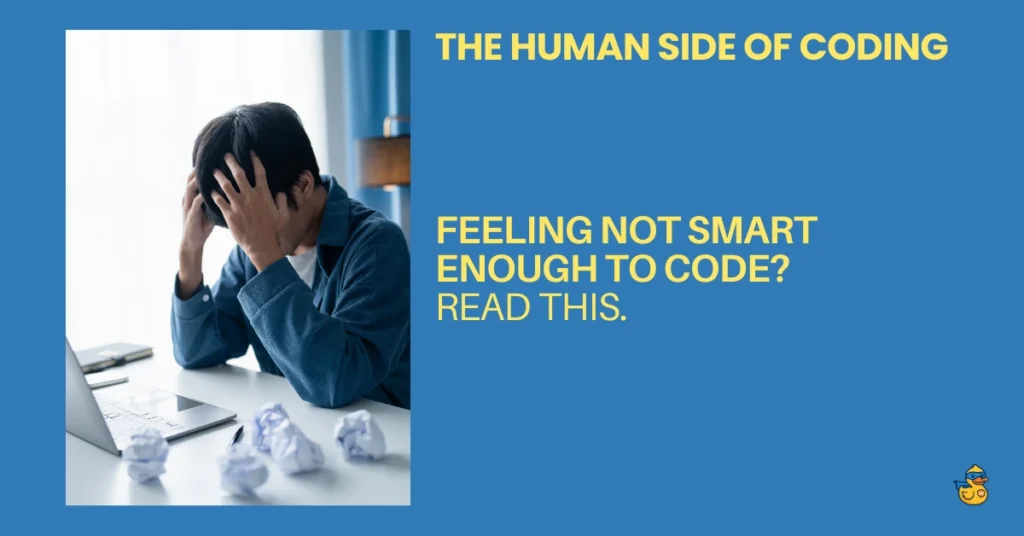


If you’ve ever sat in front of your screen and thought, “I’m just not smart enough to code,” I want you to pause for a moment and breathe. That thought is far more common than you think, and it doesn’t mean what you think it means.
It doesn’t mean you lack intelligence.
It doesn’t mean coding isn’t for you.
It doesn’t mean you’ve hit your limit.
It usually means you’re learning something genuinely new.
Coding has a strange way of making smart, capable people feel suddenly inadequate. Error messages look judgmental. Concepts don’t click right away. And everywhere you look, someone else seems to be “getting it” faster than you are. It’s easy to turn that frustration inward and decide the problem must be you.
But here’s the truth, said gently and honestly: feeling not smart enough to code is often a sign that you’re doing real learning. The kind that stretches your brain instead of flattering it.
This post isn’t here to hype you up or tell you to “just believe in yourself.” It’s here to explain what’s actually happening when you feel this way — and why this feeling, uncomfortable as it is, does not mean you should quit.
If you’re doubting yourself right now, you’re exactly who this was written for.
Because if you’ve ever sat in front of your screen and thought, “I’m just not smart enough to code,” you’re not alone, and you’re not broken for feeling this way.
Another reassuring article: Struggling With Python? This’ll Help
What You’ll Learn
Why feeling not smart enough to code is a normal part of learning, not a sign you should quit
What coding actually requires (and why intelligence is often misunderstood)
How confusion, slowness, and self-doubt can mean your brain is learning properly
Why persistence matters more than being “naturally smart”
How to keep learning to code even when you don’t feel smart enough yet
This isn’t about proving you’re smart.
It’s about understanding why you already are — and why that’s enough.
Why So Many People Feel “Not Smart Enough to Code”
This feeling doesn’t come out of nowhere. It’s not a personal flaw, and it’s not a sign that you’re bad at learning. It’s a completely understandable reaction to the way coding is usually presented to beginners.
From the outside, programming looks clean and confident. You see short tutorials where everything works on the first try. You see people typing fast, talking fast, and jumping between concepts like it’s nothing. What you don’t see is the confusion, the dead ends, the rewrites, and the hours spent stuck on something small.
So when you sit down to learn and it feels hard, your brain fills in the gap with a painful explanation:
“Everyone else understands this. I must not be smart enough to code.”
But that conclusion is based on a distorted picture.
Coding compresses a lot of complexity into small spaces. One line of code can carry ideas about logic, structure, syntax, and rules you’ve never encountered before. When it doesn’t make sense right away, it feels personal, even though it’s not. Your brain is simply meeting something unfamiliar.
There’s also the language problem. Programming uses words you already know, but gives them very specific meanings. That alone is enough to make intelligent people feel disoriented. It’s like being dropped into a conversation where everyone speaks your language… just not in the way you’re used to.
Add comparison to that, and the doubt grows louder. You compare your inside experience to other people’s polished outcomes. You don’t see their learning curve, only their results.
So if you feel not smart enough to code, it’s worth saying this clearly:
that feeling says far more about the environment you’re learning in than about your ability to learn.
And it’s a feeling almost every programmer recognizes, whether they admit it or not.
Let’s Be Honest: Coding Makes Almost Everyone Feel Stupid at First
This part is important, and it deserves to be said plainly: coding has a way of making intelligent people feel unintelligent. Not occasionally. Not rarely. Almost universally.
When you’re new to programming, nothing feels familiar. The rules are strict, the feedback is blunt, and mistakes show up in bright red text. There’s no gentle hinting. No partial credit. Either the code works or it doesn’t. That alone can shake your confidence.
And unlike many other skills, coding doesn’t let you “kind of get it.” If one small detail is off, everything breaks. Missing a single character can stop the whole program. To your brain, that feels less like learning and more like constant failure, even though it’s not.
This is why so many beginners quietly think, “If I were smarter, this wouldn’t be so hard.”
But that’s a misunderstanding of what learning looks like here.
Coding doesn’t reward instant comprehension. It rewards exposure. It rewards repetition. It rewards staying with confusion long enough for patterns to form. And in the early stages, confusion is unavoidable. It’s not a detour. It’s the road.
Ask almost any experienced developer how they felt at the beginning, and you’ll hear the same story told in different ways: frustration, self-doubt, and the unsettling feeling of not being cut out for it. The difference isn’t that they were smarter. The difference is that they didn’t leave.
So if coding makes you feel lost, overwhelmed, or slower than you expected, take that as a strange kind of reassurance. You’re not doing it wrong. You’re doing exactly what learning looks like before understanding has had time to arrive.
“Am I Smart Enough?” Is the Wrong Question to Ask
When you feel stuck, frustrated, or overwhelmed, your brain looks for an explanation. And the easiest one to grab is, “Maybe I’m just not smart enough to code.” It feels logical. Neat. Final.
But it’s also the wrong question.
Coding doesn’t sort people into “smart enough” and “not smart enough.” It sorts them into people who keep going and people who stop. Intelligence, in the way most of us think about it, just isn’t the deciding factor here.
What actually matters is whether you’re willing to:
sit with confusion without panicking
try again after something doesn’t work
reread the same idea more than once
accept that understanding arrives slowly
stay curious instead of self-critical
Those aren’t measures of intelligence. They’re habits. And habits are learnable.
When someone looks “smart” at coding, what you’re usually seeing is familiarity. They’ve seen these patterns before. They’ve made these mistakes already. Their brain isn’t working harder than yours, it’s just working on ground it’s walked many times.
So instead of asking, “Am I smart enough to code?” try asking something much more useful:
“Am I willing to be confused for a while?”
Because confusion isn’t a sign that you lack ability. It’s a sign that your brain is stretching into new territory. And that stretch — uncomfortable as it is — is exactly where learning happens.
If you can stay there without quitting, you’re already doing the most important part right.
What “Smart Enough” Actually Means in Coding
When people say they’re “not smart enough to code,” they’re usually picturing a very specific kind of intelligence. Fast thinking. Instant understanding. Remembering everything at once. Never getting stuck.
That version of “smart” is loud, flashy, and honestly… not very useful in real programming.
Coding doesn’t rely on genius-level thinking. It relies on a much quieter set of skills, and most of them grow with practice, not talent.
Here’s what being “smart enough” for coding really looks like:
You can follow a chain of logic, even if it takes time.
You don’t need to see the whole solution at once. You just need to handle one step, then the next.
You can notice when something doesn’t behave the way you expected.
That moment of “huh, that’s weird” is the start of every good debugging session.
You can ask “why” instead of giving up.
Why did this break? Why does this work here but not there? Why does changing this line fix it?
You can tolerate not knowing yet.
This one matters more than almost anything else. Coding rewards people who can stay calm in the middle of uncertainty.
None of these require a special brain. They’re not tied to IQ scores, math talent, or being “good at computers” as a kid. They’re behaviors. And behaviors can be learned.
So if you’re worried you’re not smart enough to code, here’s the gentle truth: if you can think step by step, notice patterns, and stay curious even when things don’t click right away, you already have what coding asks for.
The rest isn’t intelligence.
It’s time.
Feeling “Not Smart Enough to Code” Is Often a Sign You’re Learning Properly
This might sound strange, but it’s important: that feeling of “I’m not smart enough to code” often shows up when learning is actually working.
When learning feels easy, it’s usually because you’re skimming the surface. You’re following steps, copying patterns, and staying in familiar territory. It feels good, but it doesn’t last very long. The moment something changes, the confidence disappears.
Real learning feels different.
It feels slow.
It feels messy.
It feels uncomfortable.
When your brain is forced to build new connections instead of reusing old ones, it protests. It tells you you’re behind. It tells you this shouldn’t be so hard. It tries to protect you from the discomfort by suggesting you quit.
That voice doesn’t mean you lack ability. It means your brain is doing deep work.
Think about it this way: if you lift a weight that’s too light, you barely feel it. Lift one that actually challenges you, and your muscles shake. Learning works the same way. The strain is the signal.
So when coding makes you question yourself, it’s not proof you don’t belong. It’s proof you’re stretching beyond what you already know. That stretch is where understanding forms, even if it doesn’t feel productive yet.
Many people mistake comfort for progress and discomfort for failure. In learning to code, it’s often the opposite. Comfort means you’re repeating what you already know. Discomfort means something new is being built.
So if you’re sitting there thinking, “Why does this make me feel so dumb?” try reframing it gently:
“This feels hard because I’m learning something real.”
That shift won’t remove the frustration, but it will keep it from turning into self-doubt. And that alone can make the difference between someone who stops and someone who keeps going.
What Actually Stops People From Learning to Code (It’s Not Intelligence)
If intelligence were the deciding factor, programming would be a tiny club. It isn’t. The real reasons people stop learning to code are much quieter — and much more human.
Most people don’t quit because they’re “not smart enough.”
They quit because of fear.
Fear of making mistakes.
Fear of looking foolish.
Fear of being slower than everyone else.
Fear that the confusion means something is wrong with them.
Coding is one of the few skills where you get immediate, unforgiving feedback. The computer doesn’t soften the message. It doesn’t say “almost.” It just says “no.” Over and over. For beginners, that can feel personal, even when it’s not.
Another big reason people stop is comparison. They look sideways at others who seem to be progressing faster and assume they’re behind. They don’t see the hours of prior experience, the background knowledge, or the editing cuts. They just see the highlight reel and measure themselves against it.
And then there’s expectation. Many beginners believe that if they were smart enough, things would click quickly. When that doesn’t happen, they conclude the experiment is over. But that expectation is false. Coding clicks slowly for almost everyone who truly learns it.
The people who make it aren’t the ones who never doubted themselves. They’re the ones who doubted themselves and kept going anyway. They allowed confusion to exist without turning it into a verdict on their ability.
So if you’re struggling, stuck, or questioning yourself, try to remember this: what’s stopping most people isn’t a lack of intelligence. It’s the belief that intelligence should look different than it actually does while learning something new.
If you can stay curious a little longer, you’ve already cleared the biggest obstacle there is.
If You’ve Ever Thought “I’m Too Dumb for This,” Please Hear This
That thought feels heavy.
It usually shows up late at night, after staring at the same piece of code for too long, when nothing makes sense anymore. It doesn’t shout. It whispers. And because it whispers, it sounds believable.
“Maybe I’m just too dumb for this.”
If that sentence has ever crossed your mind, I want you to know two things.
First: you are not alone.
Second: that thought is lying to you.
It’s not a diagnosis.
It’s not insight.
It’s fatigue mixed with frustration.
Your brain reaches for that explanation because it’s simple. It gives the pain a reason. But the real reason is much less dramatic and much more human: you’re tired, you’re learning something difficult, and your brain is overloaded.
That’s when self-doubt gets loud.
The truth is, intelligence doesn’t disappear when you open a code editor. The same brain that solves problems in other parts of your life didn’t suddenly stop working. It’s just operating in a new environment with new rules, new language, and no familiar shortcuts yet.
Everyone who learns to code goes through this phase. Some talk about it openly. Many don’t. But it’s there, quietly shared by beginners and experienced developers alike.
What matters is what you do after that thought appears.
You can believe it and walk away.
Or you can recognize it for what it is: a temporary response to difficulty.
Feeling stupid doesn’t mean you are stupid.
It means you’re learning something that hasn’t settled yet.
And if you can sit with that feeling without turning it into a final judgment about yourself, you give understanding the time it needs to arrive.
How to Learn Coding When You Don’t Feel Smart Enough
When confidence is low, advice often gets loud. “Push harder.” “Study more.” “Just be disciplined.” None of that helps when the real problem isn’t effort: it’s self-doubt. That’s what all that “I’m not smart enough to code” comes from.
Here’s a gentler, more effective way to keep learning when you don’t feel smart enough.
Go slower on purpose.
Speed creates pressure. Pressure feeds doubt. Slowing down gives your brain room to breathe and actually connect ideas. One concept that truly clicks beats five that sort of make sense.
Lower the bar for progress.
Progress doesn’t have to look impressive. Understanding why one line works is progress. Fixing one small bug is progress. Showing up for twenty minutes is progress.
Ask basic questions without shame.
Every expert once asked the same “obvious” questions you’re asking now. The difference is they asked them anyway. Curiosity is a strength, not a confession.
Build tiny things.
Big projects magnify self-doubt. Small ones build confidence. A simple script that works teaches more than a half-finished app that overwhelms you.
Repeat without guilt.
Rewatching, rereading, rebuilding — that’s not failure. That’s how learning sticks. Repetition isn’t a sign you’re behind; it’s how your brain lays down memory.
Take breaks before frustration turns personal.
When confusion turns into “something’s wrong with me,” it’s time to step away. Rest isn’t quitting. It’s maintenance.
Most importantly, remember this: learning to code isn’t a test of intelligence. It’s a practice of patience. If you keep practicing — even on days you doubt yourself — you are doing exactly what this skill requires.
You don’t need to feel smart enough to continue.
You just need to continue.
Take a test to see if you’re smart enough to code: Am I Smart Enough to Code? Take This Test
Let’s Be Clear About This: You Are Smart Enough to Code
Let’s say this plainly, because people searching for “not smart enough to code” rarely hear it said out loud:
You are smart enough to code.
If you’re reading this, struggling, doubting yourself, wondering whether your brain is somehow “missing something,” that does not mean you’re not smart enough to code. It means you’re learning something complex in an honest way.
Most people who believe they’re not smart enough to code are actually doing the hardest part already:
they’re thinking.
they’re questioning.
they’re trying to understand instead of memorizing.
That’s not a lack of intelligence. That’s the presence of it.
Coding does not require a special kind of brain. It doesn’t require you to be fast, mathematically gifted, or naturally confident. What it requires is the ability to stay with a problem even when you don’t understand it yet. And if you’re worried about being not smart enough to code, chances are you’re already doing exactly that.
The irony is this:
people who truly aren’t willing to learn rarely ask whether they’re smart enough.
They quit without questioning themselves.
The people who ask “am I smart enough to code?” are usually the ones who care deeply about understanding things properly. They want to do it right. They want it to make sense. That mindset is far more important than raw ability.
So when that thought shows up again — “maybe I’m not smart enough to code” — try to recognize it for what it is. Not a fact. Not a diagnosis. Just a moment of doubt during a difficult learning process.
You don’t need to prove you’re smart enough to code.
You don’t need permission.
You don’t need to feel confident yet.
If you’re willing to keep showing up, asking questions, and sitting with confusion a little longer, then you already meet the only real requirement there is.
You are smart enough to code.
Even on the days it doesn’t feel like it.
Let’s Wrap Up: If You Feel Not Smart Enough to Code, This Is Your Sign to Keep Going
If you came here because you feel not smart enough to code, I hope one thing is clear by now: that feeling is not evidence of your limits. It’s evidence that you’re learning something real.
Coding has a way of stripping away confidence before it builds it back stronger. It makes capable people question themselves. It turns unfamiliarity into self-doubt. And when progress is slow or confusing, the brain reaches for the simplest explanation: maybe I’m not smart enough to code.
But that explanation doesn’t hold up.
People who aren’t smart enough to code don’t wrestle with ideas.
They don’t reread concepts.
They don’t worry about understanding things properly.
You do.
Feeling not smart enough to code doesn’t mean you should stop. It means you’re in the middle of the process — the part where understanding hasn’t arrived yet, but is quietly forming. That uncomfortable space is where learning actually happens.
You don’t need to be exceptional.
You don’t need to be fast.
You don’t need to feel confident today.
You just need to stay.
So the next time that thought shows up — “I’m not smart enough to code” — try answering it gently instead of believing it. Tell yourself the truth: this feels hard because it’s new, not because I’m incapable.
You are smart enough to code.
Even when you’re confused.
Even when you’re slow.
Even when you doubt yourself.
And especially when you keep going anyway.
Need more uplifting reassurance? Read this: The Truth About Being a Slow Coder (It’s Not What You Think)