
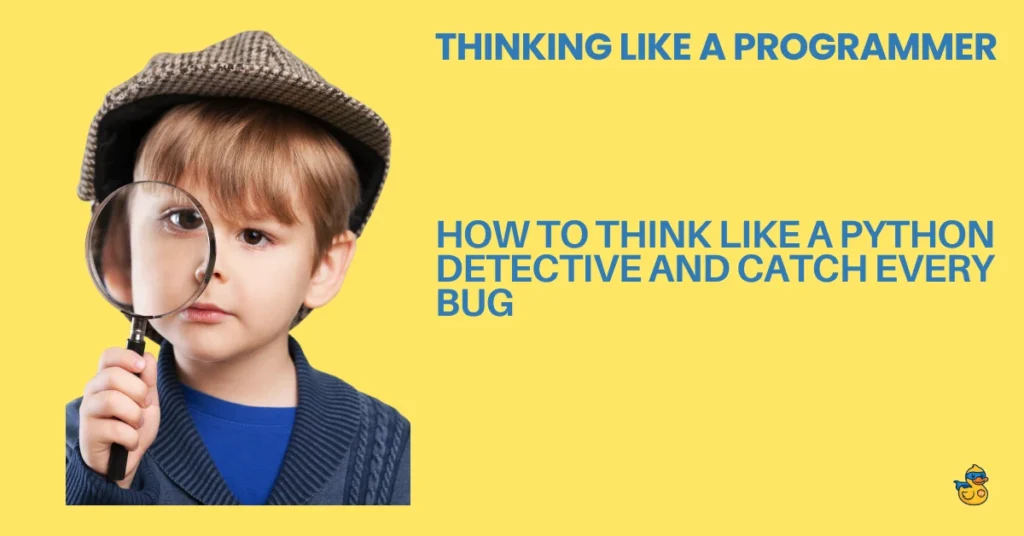
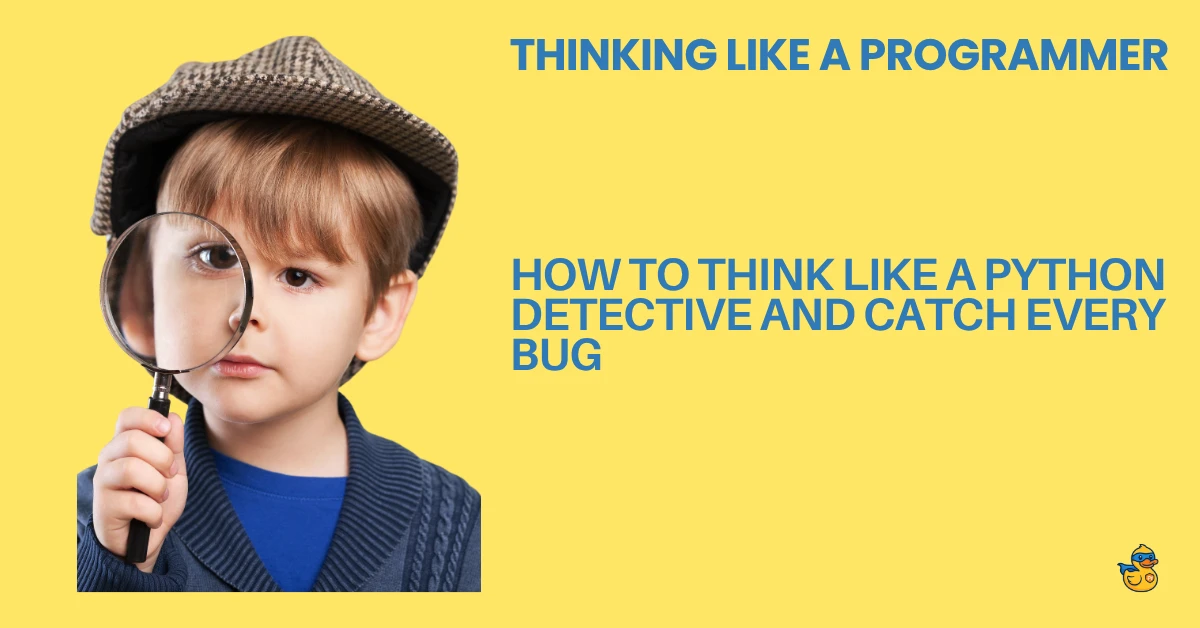

The screen flashes red. Your code is guilty of something terrible, but you can’t quite prove what. You squint at the traceback, pace around like a detective at a crime scene, and mutter, “It worked five minutes ago.” Classic case.
Every programmer eventually becomes a kind of detective. You follow clues (error messages), question witnesses (your assumptions), and reconstruct what happened until the truth emerges. Debugging isn’t just about fixing code; it’s about investigating why it broke in the first place.
Being a Python Detective means replacing panic with curiosity. You stop guessing and start observing. You learn to see patterns others miss, and sometimes even enjoy the chase.
In this post, we’ll learn how to investigate your code like a true Python Detective, calm, logical, and ready to catch every bug in the act.
Related: Free Pseudocode Generator
Want to Learn Much More? Read This: The Ultimate Guide to Thinking Like a Programmer [Python Edition]
Step One: Observe the Scene of the Crime
Every great investigation starts with observation. When your program crashes, resist the urge to start editing everything in sight. A good Python Detective doesn’t rush in with wild guesses, they look carefully at the evidence first.
That red error message? That’s not an insult; it’s a witness statement. Read it. Slowly. The line number, the error type, and even the stack trace are clues left behind by your code. They’re telling you where the problem began and sometimes even why it happened.
If there’s no error message at all, that’s still a clue. Silence means something isn’t being reached or printed. It’s your job to figure out which line went missing in action.
So before you rewrite half your code in frustration, take a breath. Scan the scene, read the evidence, and make notes. Because every good Python Detective knows: before you solve the mystery, you have to understand the crime.
Step Two: Recreate the Crime
Once you’ve examined the evidence, it’s time to retrace the crime. What exactly happened before your code broke? What input did you give it? Which line ran last before the crash?
A skilled Python Detective doesn’t just fix bugs, they reproduce them. That means running the same code again under the same conditions to confirm what triggered the problem. If you can make it happen twice, you’re already halfway to solving it.
Try narrowing it down: comment out parts of your code and test smaller sections. Run only the function you suspect. Add print statements to see what’s really going on. You’re reconstructing the moment of failure, frame by frame, like a detective replaying security footage.
Sometimes, you’ll even discover that your bug only appears under certain conditions: a specific value, a missing input, or a case you didn’t consider. That’s when you can finally say, “Aha, so that’s how it happened.”
Remember: detectives don’t solve mysteries by guessing; they recreate the scene until the truth becomes impossible to ignore.
Step Three: Interrogate the Suspects (Your Assumptions)
Most bugs don’t hide in Python, they hide in your head. A Python Detective cross-examines their assumptions.
Start with the classics:
“This variable is definitely an int.” Is it? Print it.
“The loop runs ten times.” Count it.
“The list has items.” Check its length.
“This function returns what I think.” Log the return value.
Assume nothing without evidence. Treat every belief like a witness who might be lying under oath. If your code depends on it, verify it.
Quick interrogation kit:
Print types:
print(type(x))Sanity checks:
print("reached A")Boundaries: off-by-one tests (0, 1, last index)
Edge inputs: empty strings, None, zeros, huge numbers
When an assumption fails the interview, you’ve found your suspect.
Step Four: Gather Evidence and Test Hypotheses
A Python Detective doesn’t guess, they collect proof and run experiments.
Start with evidence:
Trace values with prints:
print("i:", i, "total:", total)Check types early:
assert isinstance(price, float)Log branches:
print("took discount path")Use a breakpoint:
import pdb; pdb.set_trace()(or your IDE’s debugger)
Form a hypothesis: “The bug appears when n == 0.”
Test it by changing one thing at a time. If you tweak five lines and the bug vanishes, you’ve solved nothing: you’ve buried the body.
Build a tiny lab:
Reduce to a minimal reproducible example.
Add a quick test:
					def test_zero_items():
    assert total([]) == 0
- Run it. If it fails, you’ve got a hard clue you can rerun until it’s fixed.
Evidence first, hypothesis second, experiment third. That’s how a Python Detective closes cases.
Step Five: Find the Motive and the Fix
Catching the culprit is good; understanding why it offended is better. A Python Detective always asks: what was the motive?
Common motives
Type mix-ups:
"5" + 5or integer division assumptions.Off-by-one: ranges, indices, slice bounds.
Mutable defaults:
def f(x, bag=[])quietly sharing state.Shadowed names: local
listhiding the built-in.State leaks: variables reused across iterations or tests.
Data shape drift: you expected a dict, got a list of dicts.
Write the confession
Cause: “Loop skipped last element due to
range(len(a)-1).”Fix: “Use
range(len(a))or iterate values directly.”Prevention: “Prefer
for item in aand add a boundary test.”
Turn motive into policy
Add tests for edges (empty, one item, max size).
Lint/type-check (
ruff,mypy) to catch type and shadowing issues.Guard rails in code (assertions, explicit conversions).
Don’t just patch, vaccinate your code against repeats.
Step Six: Write the Case File
Once you solve a bug, the story shouldn’t end there. Good Python detectives write a report, not because someone told them to, but because they know the next case will look suspiciously similar.
That’s what you should do too. Keep a small “bug diary”: a notebook, a file, or even a few sticky notes. The point is simple: don’t let your hard-earned lessons vanish.
Here’s how to write your case file, step by step:
1. Describe the symptom
Start with what went wrong, in plain language.
“My program said 9 when it should’ve said 10.”
“The app crashed when I pressed Enter without typing anything.”
Keep it human, something you’d understand three months from now.
2. Describe what caused it
Explain the real reason behind the problem, not just the surface error.
“The loop stopped one step too early because I used
range(len(numbers) - 1)instead ofrange(len(numbers)).”
“My input was empty, and I didn’t tell the program what to do when that happens.”
This is the “aha” moment, what you wish you’d noticed sooner.
3. Describe how you fixed it
Note what finally worked.
“Changed the loop to
for number in numbers:so it runs through every item.”
“Added anifstatement to check if the input is empty.”
Even if it seems obvious now, future-you will thank you for writing it down.
4. Describe how you’ll prevent it next time
This turns your fix into a habit.
“I’ll always test my code with an empty list.”
“I’ll double-check that my loops go all the way to the end.”
That’s how small improvements pile up until you think like a natural debugger.
You don’t have to write a novel, just a few notes every time you solve a bug, like a good Python detective. Over time, you’ll start noticing patterns: maybe you often forget edge cases, or mix up variable types. Those patterns are pure gold, they show where your coding instincts are still learning.
Your case file isn’t for anyone else. It’s a conversation between present-you and future-you, and future-you will read it, smile, and say, “Ah, I remember this one. Easy fix.”
Step Seven: The Detective’s Mindset - Calm, Curious, Consistent
Debugging isn’t punishment, it’s detective work with extra semicolons. The best programmers don’t panic when something breaks; they slip into investigation mode. They become Python Detectives: calm, logical, and quietly confident that every mystery has a reason.
Here’s what that mindset looks like:
1. Stay calm
Bugs love panic. When you’re frustrated, your brain stops observing and starts guessing. Take a breath, step away for a minute, or explain the problem to SuperPyDuck. A clear head finds clues faster than a stressed one.
2. Stay curious
Every bug is a question, not an accusation. Ask why instead of what. “Why did this variable change?” “Why is this loop never ending?” Curiosity turns debugging from a chore into a puzzle, and puzzles are fun once you stop taking them personally.
3. Stay consistent
Python detectives solve cases because they keep showing up. They test theories, gather clues, and take notes, even when it’s boring. In programming, small habits like testing your code often, printing values for clarity, or handling edge cases before they explode make a massive difference over time.
4. Celebrate small wins
Every time you find a bug, you just became a little sharper. Even if it took an hour to realize you misspelled a variable, that’s not failure, that’s growth. Python detectives don’t mock themselves for missing clues; they just add them to the list of things they’ll catch faster next time.
The Python detective mindset is what separates coders from problem solvers. Anyone can follow a tutorial. But a Python Detective? They can walk into a digital crime scene, dust off the stack trace, and calmly say, “Let’s find out what happened here.”